Sterling Sign: Capturing Urban Energy in Typography
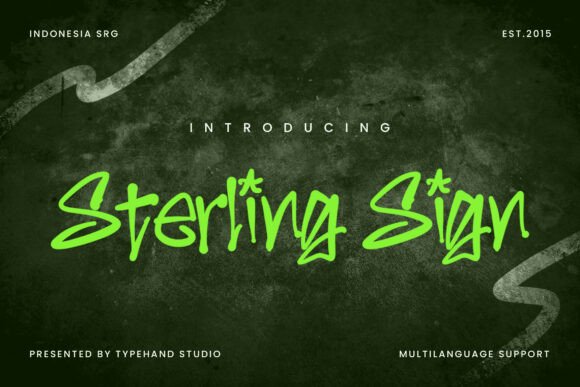
In a digital world saturated with clean, geometric sans serif fonts, there’s a powerful pull toward typography that feels human, immediate, and real. This is where Sterling Sign enters the conversation. It’s not just another typeface; it’s a visual handshake, a piece of marker-scrawled attitude captured for modern design. Built on the foundation of street culture and the loose, confident strokes of a marker, this display font is engineered for projects that demand personality over perfection. If you’ve ever tried to force a standard font to look "edgy" or "cool," you know the result often feels contrived. Sterling Sign avoids that trap entirely because it was born from that aesthetic.
The defining characteristic of this premium font is its rhythm. It doesn’t sit still on the page. The letterforms mimic the natural variance of a human hand moving quickly across a surface, resulting in organic line movement that feels energetic rather than static. You’ll notice slight inconsistencies in baseline and stroke weight—not enough to ruin legibility, but just enough to inject a sense of authenticity. This is the sweet spot for modern typography: a design that feels handmade but performs like a professional tool. It captures the raw confidence of skate graphics and the visual punch required for streetwear labels, making it an ideal choice for logo design where the name needs to stick in the viewer's mind instantly.
Strategic Applications: Where Sterling Sign Delivers
Understanding where a font like this fits is crucial for maintaining your brand's credibility. Because Sterling Sign is a high-impact display font, it shines brightest in contexts where brevity and visual weight are key. It is rarely the right choice for long-form body copy, but it is unrivaled for headlines, hero text, and branding marks. If you are developing a brand identity for a lifestyle brand, a fitness label, or a creative agency, this typeface can serve as the primary voice for your headers. It pairs exceptionally well with a clean, geometric sans serif font for body text. The contrast between the expressive, loose rhythm of Sterling Sign and the structured rigidity of a sans serif creates a sophisticated visual hierarchy that guides the reader’s eye naturally.
For those in the apparel industry, the applications are obvious but worth detailing. This font excels in packaging design and merchandise. Think about the hangtags on a new clothing line, the graphic on a tote bag, or the branding on a skate deck. Sterling Sign provides that "lived-in" quality that suggests the product is part of a culture, not just a commodity. Beyond physical goods, it is a powerhouse for social media graphics. In the fast-scroll environment of Instagram or TikTok, a standard serif or sans serif can easily be glossed over. The sharp, marker-inspired edges of Sterling Sign create a visual interruption that stops the thumb. It is perfect for overlaying on photography, adding a layer of grit to urban landscapes or action shots.
Furthermore, don't overlook its utility in editorial design and web design. While you wouldn't use it for a blog post body, it transforms a magazine cover, a feature article header, or a website landing page. It brings a youthful energy that can make even corporate or educational content feel more accessible and contemporary. For music visuals, specifically for genres like hip-hop, punk, or indie rock, the font feels native to the medium. It eliminates the need for expensive hand-lettering commissions, offering a consistent creative font solution that maintains its character across different sizes and mediums.
Designing with Confidence: Pairing and Usability
One of the most common challenges with handwritten fonts is readability at smaller sizes. Many script or marker fonts become illegible blobs when scaled down. Sterling Sign has been engineered with this in mind. The open letterforms and distinct character shapes ensure that it remains legible even when used in sub-headers or button text. However, for maximum effectiveness, always test your typography in context. A font that looks great on a desktop monitor might lose its punch on a mobile device if the tracking is too tight.
When it comes to font pairing, the goal is to let Sterling Sign do the heavy lifting for the "vibe" of the project, while a secondary typeface handles the information. A classic serif font can actually work surprisingly well here, creating a "high-low" aesthetic that feels very editorial and fashion-forward. Imagine Sterling Sign as the headline for a magazine spread, paired with a refined serif for the subtext. Alternatively, a sturdy, industrial sans serif reinforces the streetwear aesthetic. Avoid pairing it with other script fonts or overly decorative typefaces, as this will create visual clutter and dilute the message.
For entrepreneurs and small business owners, evaluating a commercial font often comes down to versatility and licensing. It is vital to review the licensing terms to ensure they cover your specific use case, whether that is digital advertising, print-on-demand merchandise, or software embedding. A professional typeface like this usually comes with different weights or styles—perhaps a bold version for extra punch or a light version for a more subtle touch. Check for these variations, as they expand the utility of your design assets. Ultimately, choosing Sterling Sign is about aligning your visual communication with a specific mindset: one that is bold, creative, and unapologetically energetic. It is a tool for those who want their brand to feel alive.